Chronic leukemia is often treatable when it is diagnosed early. However, once the cancer has reached the blast phase it is often fatal and it is included in the Social Security Administration’s list of compassionate allowances. Inclusion on the list of compassionate allowances will allow your case to proceed through the eligibility process faster than it otherwise would, but it does not change the criteria for Social Security disability eligibility.
You may be eligible for Social Security disability benefits if you meet the requirements in the Listing of Impairments or if you are unable to work because of your cancer.
According to Section 13.06 of the Listing of Impairments, people who suffer from chronic myelogenous leukemia may qualify for benefits in one of two ways. You may be eligible for benefits if one of the following is true:
Additionally, you may be eligible for benefits if you can prove that your chronic leukemia is equal in severity to another listing in the Listing of Impairments or if you are unable to work any job because of your medical condition.
You are already fighting every day to manage your chronic leukemia, to comply with your doctors’ orders, and to live out the rest of your life on your terms. The last thing that you need is another fight for the Social Security disability benefits that you’ve earned.
However, it can be difficult to convince the Social Security Administration that you are eligible for Social Security disability benefits. Our experienced Social Security disability lawyers can remove this stress from your shoulders and work hard to get you the fair and just benefits you deserve. We will work with you to file a complete application or to appeal a denial of benefits. Please contact us today via this website or by phone to learn more.

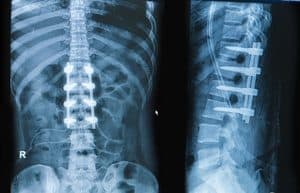 Yes, you may be eligible for Social Security disability benefits if you underwent spinal fusion surgery and you remain disabled after the surgery. You likely consented to this type of serious spinal surgery with the hope and the expectation that you would feel better and that your quality of life would improve after surgery.
Unfortunately, spinal fusion surgery has risks and those risks can leave you disabled. Instead of feeling better after spinal fusion surgery, you may experience:
These risks can result in permanent medical conditions that leave you unable to work.
You may be eligible for Social Security disability benefits if you can prove that your disability is included in the Social Security Administration’s Listing of Impairments (known as the Blue Book) or if you can prove that you are totally and permanently disabled and unable to work.
You may qualify if you meet the requirements of Section 1.04 of the Listing of Impairments. This section, which covers disorders of the spine, allows you to recover disability benefits if you have a spinal condition that results in the compromise of a nerve root or of the spinal cord and one of the following is also true:
Finally, you may qualify if you can prove that you meet another section of the Blue Book or if you can prove that your residual functional capacity is so diminished by your condition that you cannot work. For example, if your spinal fusion surgery left you unable to walk, your condition may be equal in severity to Section 1.03 of the Blue Book which applies to the surgery or fusion of weight-bearing joints. While the spine is not a weight-bearing joint, the effect of your spinal fusion surgery may be the same as a fusion surgery on a hip, knee, or other weight-bearing joint.
You will need medical evidence and a complete and compelling Social Security disability application in order to get the benefits you deserve. For help submitting a strong application or for a fair review of your claim, please contact a board certified Social Security disability lawyer today via this website or by phone.
It depends. Some people with prosthetic limbs are eligible for Social Security disability benefits and others are not eligible for benefits. At first glance, this may seem arbitrary or unfair. However, the Social Security Administration considers specific factors to determine whether a person with a prosthetic limb is eligible for disability benefits.
If you have a prosthetic limb that allows you to walk effectively, your application for Social Security disability benefits may be denied. However, you may be eligible for benefits if you can prove that even with a prosthetic limb:
Your prosthesis may dramatically improve your quality of life, but you may still be unable to do the work you did prior to your amputation or to perform another job.
When you submit your Social Security disability application, it is important that you have accurate and complete information to prove that you are unable to work. This includes, but may not be limited to:
Social Security disability applications can be complicated, but it is important to fill them out fully and correctly so that you can start getting the benefits you deserve as soon as possible. To learn more, please read our free Social Security Disability Fact Sheet and contact us directly for a free consultation.
 You can only receive Social Security disability benefits if you have paid enough into the Social Security system. The Social Security Administration (SSA) determines whether you qualify based on the number of work credits you have earned and your age.
Each year, work credits are calculated from your income taxes. The amount that you must earn before earning a credit is re-evaluated and adjusted as needed according to the average wage index—the constant being that you can only earn four credits in one year, no matter how large your income.
For applicants born after 1929 who became disabled from age 31 to 61, the number of work credits you need will change every couple of years. To illustrate:
Keep in mind that as long as you aren’t applying due to blindness, at least 20 work credits must have been earned in the ten years prior to filing.
Once you determine that you have the necessary work credits to apply for Social Security disability, you will need to prove that you are eligible for benefits because you have a qualifying disability that will keep you from working for 12 months or longer or that is expected to be fatal.
Applying for Social Security disability benefits can be confusing, but it is important to your future. If you have questions about Social Security disability eligibility or the claims process, we encourage you to contact us directly to schedule an initial consultation. You can also request a FREE copy of our book, Social Security Disability: What You Need to Know to learn about protecting your rights.
Yes, your daughter may qualify for Social Security disability benefits even if her IQ is not quite low enough to qualify her as having an intellectual disability. However, building a compelling case for Social Security disability benefits will involve a lot of legwork and a thorough knowledge of how the Social Security disability system works.
If your daughter’s IQ is between 71 and 84, she is in the range of borderline intellectual functioning (BIF). People with BIF do not have an intellectual disability for purposes of Social Security disability benefits, and if a lower-than-average IQ score is her only issue, then she won’t be able to obtain benefits.
However, if your daughter has mental functional capacity issues that extend beyond her IQ score, she may qualify for Social Security disability benefits.
Before you have your child apply for Social Security disability, it is important to gather all of the information that will be relevant to her application, including:
You may also want to seriously consider hiring an experienced disability attorney to help you navigate the challenges of proving your daughter’s disability claim in spite of these special circumstances. To learn more, call Morgan Weisbrod today. Our compassionate and skilled team is here to answer your questions and to help your daughter get the disability benefits she deserves.
 While it’s true that providing the Social Security Administration with a Residual Functional Capacity (RFC) form completed by your treating physician is not required as part of your application for Social Security disability benefits, the form plays a crucial role in the decision process, and will be completed either way. If you haven’t provided a form from your doctor, then one will be filled out at Disability Determination Services (DDS) by a medical consultant who will work off your records.
Although your medical records will contain comprehensive documentation of your disabilities, they will not contain a full picture of the impact your disabilities have on your ability to consistently perform the functions necessary to maintain employment. That kind of insight can only come from a medical professional who has an ongoing relationship with you. This is why significant weight is given to an RFC form completed by your physician.
So while it’s tempting to “let your medical records speak for themselves,” especially if your doctor charges a fee to complete the RFC form, it’s in your best interest to have your doctor fill out the form. Typically, the fee charged by your doctor is small and the benefit to having your doctor complete the form is significant.
Each decision—such as whether to have your doctor complete the RFC form—can have important consequences in your eligibility determination. Accordingly, it is important to make sure that you are making the right decisions for your claim. You can begin getting the advice you need about the Social Security disability application process or appeals process now by contacting our board-certified disability attorneys via this website or by phone. Additionally, we invite you to download a free copy of our book, Social Security Disability: What You Need to Know, for more important information.
 Generally, there are four different levels of appeal when it comes to your Social Security disability claim. You may have the right to appeal your Social Security disability claim in a:
Although this means, in theory, that you have four different opportunities to appeal your case, it does not necessarily mean that you can or should appeal at each level. In most cases, claimants who have their initial appeal denied will appeal twice: they will file a request for consideration (the Social Security Administration (SSA) only grants about five percent of these requests), and they will go to an administrative law judge hearing.
The Appeals Council selects disability claim cases to review—and often it chooses cases in which an interesting issue is raised or in which substantial evidence has come to light. Only a handful of cases find success at this level.
After the Appeals Council, you may file a lawsuit against the SSA in federal court. Although this option gives you a better chance at success than the Appeals Council, it can be a long and possibly expensive process.
Your aim should be to appeal as few times as possible because your ultimate goal is to get the fair Social Security disability benefits you deserve quickly. Thus, it is important to put in as much work as you can to get your application approved the first time or at the next level of appeal so that you can avoid the time, the expense, and the frustration of further appeals.
To find out more about the appeals that you should file and about how to protect your rights, please contact a board certified disability lawyer today for more information. We will help you make the right decisions about your claim.
Yes, you can receive Social Security disability benefits if you have been diagnosed with a terminal illness and you meet the requirements of the Social Security disability program. In fact, your application for benefits may be expedited through the Social Security Administration’s terminal illness program known as TERI.
According to the Social Security Administration, you may be eligible for TERI if you are diagnosed with “a medical condition that is untreatable and expected to result in death.” Some conditions, such as amyotrophic lateral sclerosis (ALS), may automatically classify your application as a TERI case. Other conditions that are often added to the TERI program include some forms of cancer, chronic heart failure, fatal genetic issues in newborns, and those on life-sustaining devices such as a ventilator.
You may claim that you have such a condition in your Social Security disability application, or the Disability Determination Services (DDS) may identify your application as a TERI case based on the content of your application.
DDS is not required to tell you that your case is being considered as a TERI case and is specifically instructed by the Social Security Administration not to use the word terminal in anything that is made available to you.
That is the responsibility of DDS management and the Social Security Administration’s field offices. DDS management is supposed to follow up on a TERI case every 10 days until an eligibility determination is made. If a determination is not made within 30 days, the field office should become involved.
If you are suffering from a terminal illness and you qualify for Social Security disability, you have the right to have your application expedited and to start receiving benefits as soon as possible. An experienced Social Security disability lawyer can help you get the benefits you deserve. Please contact us today to learn more.

Often, a disability impacts more than just your ability to work. It could also impact your ability to manage your money or to pay your bills on time, for example. In these cases, the Social Security Administration allows Social Security disability representatives to have a representative payee appointed.
A representative payee will receive a Social Security disability recipient’s monthly benefits and use that money for the benefit of the Social Security disability recipient. Specifically, the representative payee will use the money from the disability payments to pay for the Social Security disability recipient’s rent, mortgage, utilities, food, clothing, personal care and home care items, medical expenses, and to cover any other necessary expenses. Extra money can be used on entertainment, education, or home improvements for the person with the disability or can go into a savings account for the benefit of the person with a disability. A payee should never use the disability payments for something other than the benefit of the Social Security recipient.
A payee is usually a family member, partner, close friend, or loved one. However, payees are sometimes a nursing home, an adult care facility, or another institution.
If you think your loved one needs a representative payee and you are willing to serve in that role, you should:
Do you have questions about acquiring Social Security disability benefits or selecting a representative payee? Contact our experienced Social Security disability lawyers today to schedule an initial consultation and to get the advice you need to move forward.
 In 2015 (the most recent year for which statistics are available), 15 million people, or 10.1 percent of the American workforce, was self-employed. Texas was right in line with the national average with 10% of the workers in this state being self-employed, according to the Bureau of Labor Statistics.
If you are self-employed or work as an independent contractor or freelancer, do you still qualify for Social Security disability benefits? And what happens if you suffer from an injury, illness, or health condition that prevents you from continuing to work for an extended period of time?
Whether or not you are eligible for Social Security disability payments when you are self-employed depends on several factors, including:
When you are employed by another entity, your Social Security taxes are usually taken out of your paycheck. When you are self-employed, you are responsible for reporting your income and paying your Social Security taxes. As long as you pay in to the system, you have the same right to Social Security disability benefits as workers who are employed by others.
For people who are employed by others, the Social Security Administration uses a specific dollar amount to determine if they are engaged in substantial gainful activity and, therefore, able to work. The same rules do not apply to the self-employed, however. Instead, the Social Security Administration will perform a countable income test to determine if you engage in substantial gainful activity.
You are entitled to a trial work period, however, just like people who are employed by others.
Do you have questions about self-employment and disability benefits? Call our experienced Social Security disability lawyers today for more information and download a FREE copy of our report, Social Security Disability: What You Need to Know.
© 2026 Morgan Weisbrod, All Rights Reserved, Reproduced with Permission Privacy Policy | Site Map